



Artificial intelligence, which “learns” by finding patterns in data, has revolutionized weather forecasting, taking far less time and energy than traditional, supercomputer-based weather and climate models.
Yet for events that might happen once in 1,000 years—like the deadliest heat waves—there just isn’t enough historical data, and it’s costly and time-consuming to simulate enough data, to train these tools reliably to handle such uncommon events.
“AI weather and climate models are one of the great achievements of AI in science, but they’re not magical—they fail on gray swans, the rarest and most extreme events. Detailed physics-based models can capture extremes, but they require prohibitively large amounts of time and energy,” said Pedram Hassanzadeh, University of Chicago associate professor of geophysical sciences.
An international team of researchers in the United States and France, co-led by members of Hassanzadeh’s Climate Extremes Theory and Data Group, has developed a new method, published in Physical Review Letters, to solve the problem. They married the efficiency of AI tools with the trustworthiness of traditional models to help predict the odds of rare events quickly and accurately, while using far fewer resources.
“The power of this method,” Hassanzadeh said, “is that it combines the strengths of both AI and traditional physics and is particularly effective for extreme events, which are the hardest to simulate and have the greatest societal impact.”
The statistics of rare events
Heat waves are one of the deadliest forms of extreme weather. In 2003, a heat wave led to roughly 70,000 deaths across Europe, and Russia suffered 56,000 deaths in 2010. In June, nearly half of the United States—roughly 180 million people—experienced dangerous temperatures.
These waves are becoming increasingly frequent and severe, but the nature of outlier events makes them difficult to study and challenging to predict.
Forecasting has long relied on physics-based climate and weather models. They help us see how different conditions, like atmospheric pressure, might affect temperature, for instance, over time.
If you want to know the odds that Chicago will reach 90°F in July—which is not uncommon—you wouldn’t need to run many simulations before one landed on that temperature. But if you want to know the odds that it would reach 105°F, you’ll need to try many more times before you see that extreme.
Running that many simulations takes a lot of time and computational power, so the team adapted a statistical technique called rare event sampling (RES), which speeds up the process by scoring conditions so the climate model can focus on only the most promising and ignore the rest.
However, rare event sampling doesn’t work well for sudden events, like week-long heat waves. The new method, named AI+RES, boosts the scoring mechanism by adding AI’s ability to predict which conditions are most likely to lead to shorter, rapidly developing extremes.
“After doing this iteratively, you eventually get to a bunch of simulations that do indeed capture whatever rare extreme event that you’re interested in,” said Alexander Wikner, Schmidt AI in Science Postdoctoral Fellow in Hassanzadeh’s group and co–first author on the study. “The more you get, the better you can estimate the probability of that event, and that ultimately gives you a lot more certainty.”
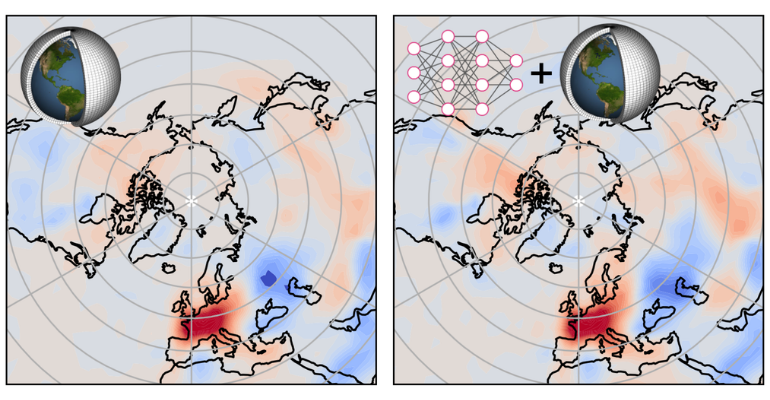
To test the method, the team ran 50,000 simulations using a traditional climate model to predict heat waves over areas of France and the U.S. Midwest. Their new AI+RES method gave nearly identical results using one-hundredth as many simulations.
Because this work was a proof-of-concept, they used a model that didn’t take into account climate change, which adds another level of complexity. The researchers hope to test their method on models running under different climate change scenarios to see how results might shift as the planet warms.
Wikner notes that the method could also help generate rare-event datasets to train even better AI models, which would then speed up their method even further.
Scaling up
According to the scientists, the hybrid method could be applied to other severe weather, including tropical cyclones or extreme precipitation, or even non-weather-based complex systems.
“What I like about this framework,” said Hassanzadeh, “is that it’s ready to be scaled. AI models trained on real weather observations are already built and in use, so the next step is to connect a state-of-the-art numerical weather or climate prediction model to one of them through this algorithm.”
This would give decision-makers access to accurate information they need, like the frequency of strong storms and heat waves in the current and future climate, at regional scales—such as specifically over Texas, Florida, or California, for instance.
“This is exactly the kind of information federal, state, and local governments need as a first step for climate adaptation and mitigation planning,” added Hassanzadeh. “It’s very exciting that we could be scaling this up into real-world models that directly provide such information to the public and to policymakers.”
Other co-authors on the study include Dorian Abbot, professor of geophysical sciences at the University of Chicago, and researchers from École Normale Supérieure in Paris; Réseau de Transport d’Electricité (RTE) in Paris; World Energy & Meteorology Council in Norwich, UK; and Courant Institute of New York University.
Citation: “AI-boosted rare event sampling to characterize extreme weather.” Amaury Lancelin, Alexander Wikner, Laurent Dubus, Clément Le Priol, Dorian S. Abbot, Freddy Bouchet, Pedram Hassanzadeh, and Jonathan Weare. Phys. Rev. Lett. August 5, 2026.
Funding: The Eric and Wendy Schmidt AI in Science Fellowship, France-Chicago Center FACCTs Award, US National Science Foundation, the Institute for Climate and Sustainable Growth at the University of Chicago, RTE France, the National Agency for Research and Technology (ANRT), and the Institut des Mathématiques pour la Planète Terre (IMPT).